 Dynova
Choosing an industrial AI server manufacturer in 2026 requires more than comparing processor names and advertised speeds. Industrial workloads demand stable performance, predictable maintenance, and measurable reliability under heat, dust, vibration, and continuous operation. A server that performs well in a laboratory may struggle beside a production line.
Gartner forecasts worldwide artificial intelligence spending will reach approximately $2.52 trillion in 2026, representing strong annual growth. McKinsey’s State of AI research also reports that 72% of organizations regularly use AI in at least one business function. These figures signal rapid adoption, but they also expose a practical problem: many companies purchase computing capacity before defining operational requirements. That mistake can create expensive idle hardware, insufficient cooling, or difficult software integration.
A credible industrial ai server manufacturer should explain its engineering choices clearly. Evaluate GPU and CPU compatibility, memory bandwidth, storage endurance, remote management, cybersecurity controls, and long-term component availability. Ask for thermal test results, failure-rate data, service response times, and references from comparable factories. Check whether the supplier supports containerized workloads, industrial networking, and deployment at the edge.
Uptime Institute’s data center research consistently highlights power availability and efficiency as major infrastructure concerns. Therefore, energy consumption deserves the same attention as benchmark scores. A smaller system may be better when it reduces cooling demand and simplifies maintenance. Yet benchmarks can mislead. They rarely show performance after months of dust, firmware changes, or sensor expansion.
The strongest choice combines documented experience, transparent testing, and realistic support commitments. No report replaces a site visit. A careful decision may still be imperfect, but it should make every assumption visible.
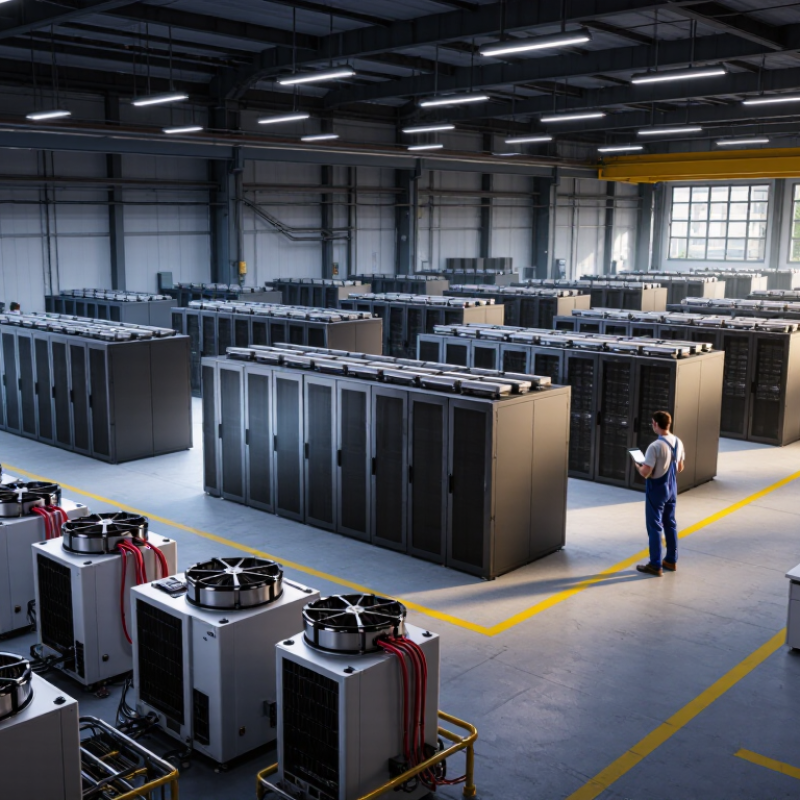
Before comparing industrial AI server manufacturers, define the workload at the production site. A vision system may analyze 12 cameras, 24 hours daily, at 30 frames per second. Another system may predict motor failures from low-frequency sensor data. These demands need different processors, memory sizes, storage, and network designs. Latency matters too. A robotic inspection task may require responses within 50 milliseconds, while batch analytics can tolerate several minutes.
Record practical details, including camera resolution, model size, inference frequency, data retention, and expected user count. Then estimate peak demand, not only average demand. Select suitable accelerators, sufficient RAM, fast NVMe storage, and expansion capacity for future sensors. ECC memory can reduce data errors. Redundant power supplies may protect continuous operations. In dusty or hot facilities, thermal design is not a minor specification. It directly affects stable performance.
I have seen teams choose servers using headline AI benchmarks alone. That approach often misses network congestion, cooling limits, and maintenance access. Paper specifications are not enough. Ask manufacturers for sustained-load test results, operating temperature ranges, firmware policies, security update periods, and replacement procedures. Request a pilot using your own models and sample data. My early capacity estimates were too optimistic because I ignored model updates and temporary storage. That mistake changed the final configuration. Leave measurable headroom, but challenge every extra component.
| Industrial AI Workload | Typical Industrial Use | Model and Data Characteristics | Target Latency | Recommended Accelerator Profile | System Memory | Storage and Data Pipeline | Manufacturer Requirements to Verify |
|---|---|---|---|---|---|---|---|
| Vision Inspection Real-time defect detection on production lines | Surface inspection, dimensional checks, assembly verification, and optical character recognition. | Convolutional or transformer-based vision models; commonly uses 1–20 megapixel images and INT8 or FP16 inference. | 10–100 ms per image The required rate depends on camera count and conveyor speed. | One low-to-mid-range inference accelerator with at least 8–16 GB of device memory for multiple camera streams. | 32–128 GB ECC RAM | 1–4 TB enterprise NVMe for the operating system, models, logs, and short-term image buffering. | Confirm deterministic response, camera and frame-grabber compatibility, isolated PCIe resources, and support for industrial temperature ranges. |
| Predictive Maintenance Failure-risk prediction from machine telemetry | Vibration analysis, motor monitoring, pump health, rotating equipment, and remaining useful life estimation. | Time-series, signal-processing, and tabular models; data may arrive from hundreds or thousands of sensors. | 100 ms–5 seconds Detection windows are usually longer than machine-control loops. | CPU inference is sufficient for many deployments; use one 8–16 GB accelerator when spectral analysis or deep sequence models are required. | 64–256 GB ECC RAM | 2–8 TB NVMe for high-write telemetry, feature stores, and local buffering; use separate capacity storage for historical data. | Check sustained write endurance, time-synchronization support, sensor protocol integration, remote diagnostics, and replacement-part availability. |
| Digital Twin and Simulation Physics, process, and equipment simulation | Production-line optimization, process planning, virtual commissioning, and engineering design analysis. | Large 3D scenes, numerical solvers, graph models, and simulation data; workloads may be CPU-, GPU-, or memory-intensive. | Seconds to several minutes Interactive visualization and batch simulation have different requirements. | One or more accelerators with 16–48 GB device memory for visualization and parallel workloads; high core-count CPUs for solvers. | 128–512 GB ECC RAM | 4–16 TB high-performance NVMe with a high-capacity data tier for CAD, simulation results, and digital-twin assets. | Validate PCIe lane allocation, multi-accelerator airflow, remote management, virtualization support, and compatibility with engineering software. |
| Generative AI and Industrial Copilots Maintenance, engineering, and operations assistance | Technical-document search, work-order summarization, troubleshooting, natural-language interfaces, and retrieval-augmented generation. | Transformer models with retrieval indexes; model size, context length, quantization, and concurrent users drive memory demand. | 0.5–5 seconds to first response Streaming output can improve perceived responsiveness. | 1–4 accelerators with approximately 16–80 GB device memory each, depending on model size, quantization, and user concurrency. | 128–512 GB ECC RAM | 4–16 TB NVMe for models, embeddings, indexes, and document caches; plan additional storage for audit logs. | Verify accelerator interconnects, container and orchestration support, model-security controls, encryption, and upgrade paths for memory and accelerators. |
| Edge AI and Machine Control Inference near machines and control systems | Robotic guidance, autonomous material handling, safety monitoring, and closed-loop process control. | Compact vision, sensor-fusion, and control models; operation may continue during intermittent or unavailable cloud connectivity. | 1–20 ms response Control-loop timing must be specified separately from model inference time. | Embedded or low-power accelerator with 4–16 GB device memory; hardware timing features may matter more than peak throughput. | 16–64 GB ECC or industrial-grade RAM | 256 GB–2 TB industrial SSD with power-loss protection and local data buffering. | Confirm deterministic networking, fieldbus and industrial Ethernet support, fanless or filtered cooling options, vibration tolerance, and secure boot. |
| Large-Scale Training and Fine-Tuning Training models with plant and process data | Vision-model training, domain adaptation, synthetic-data generation, and fine-tuning of language or multimodal models. | Large datasets, high data-loader throughput, mixed precision, distributed training, and frequent checkpointing. | Hours to days per training run Total training time depends on dataset size, model size, and accelerator count. | Multiple accelerators with 24–80 GB device memory each; high-bandwidth accelerator-to-accelerator communication is important. | 256 GB–1 TB ECC RAM | 8–64 TB high-throughput NVMe or shared storage; plan for datasets, checkpoints, temporary files, and versioned artifacts. | Evaluate PCIe topology, accelerator interconnect bandwidth, power delivery, liquid or high-capacity air cooling, cluster management, and driver lifecycle support. |
| Video Analytics and Safety Monitoring Continuous analysis of multiple video streams | Personnel safety, restricted-area detection, process compliance, traffic monitoring, and incident review. | Multiple compressed video streams, object detection, tracking, segmentation, and event-based storage. | 50–500 ms per frame Frame rate, resolution, codec, and stream count determine capacity. | One or more video-capable accelerators with 8–24 GB device memory; hardware decoding and encoding reduce CPU load. | 64–256 GB ECC RAM | 4–32 TB depending on retention policy; use high-endurance storage for continuous recording and event indexing. | Check the number of supported decode and encode streams, network ports, retention expansion, privacy controls, and 24/7 thermal performance. |
| Industrial AI Platform and Mixed Workloads Shared infrastructure for several AI applications | Centralized inference, model registry, data preprocessing, monitoring, and multiple departmental workloads. | Mixed CPU, GPU, memory, storage, and network demand with variable concurrency and service priorities. | Application-dependent Define separate service-level targets for each production application. | Select expandable accelerator capacity; support partitioning or workload isolation where required. | 256 GB–1 TB ECC RAM | 8–64 TB usable local storage plus scalable shared storage, backup, and disaster-recovery capacity. | Require redundant power supplies, out-of-band management, virtualization or container support, capacity expansion, security updates, and documented service response times. |
Test your actual models, camera resolutions, batch sizes, and data pipelines. Measure sustained throughput, inference latency, and recovery time. Five fast minutes prove little.
Request tests at the intended ambient temperature and during continuous operation. Check throttling, power use, fan behavior, and error rates. Heat changes everything.
Review core count, clock behavior, PCIe lanes, virtualization, and accelerator access. Memory should support models, containers, logs, and temporary datasets. Error-correcting memory helps continuous operation.
Measure storage latency during simultaneous reading and writing. Test packet loss, jitter, and failover under peak camera traffic. A fast connection can still face congestion.
Confirm support for operating systems, container runtimes, AI frameworks, and industrial protocols. Test real sensors, models, and pipelines. Datasheets alone are insufficient.
Look for documented APIs, version policies, remote diagnostics, and clear update procedures. Confirm communication with controllers, cameras, gateways, and supervisory systems. Fragile adapters become maintenance burdens.
Customization can address vibration, temperature, enclosure size, or expansion needs. It may complicate certification, repairs, and software updates. Define replacement sources before approval.
Request written response times, escalation procedures, spare-part locations, and support commitments. Include electricity, cooling, maintenance, licensing, and replacement parts. Purchase price is only one slice.
Leave expansion space for memory, storage, and network cards. Ask about upgrades after warranty expiration and during software changes. Growth promises need evidence.
I once overlooked cable routing, causing avoidable service delays. Include routing, access, and replacement work in testing. The checklist may still miss something.
Choosing the right industrial ai server manufacturer in 2026 begins with a clear understanding of your industrial AI workload, including model size, inference or training demands, data volume, response time, and deployment environment. These requirements should guide decisions about GPU and CPU capability, memory capacity, storage speed, and network bandwidth. A well-matched system can improve performance while avoiding unnecessary infrastructure costs.
Beyond hardware specifications, evaluate reliability, security, compliance, thermal design, and manufacturing quality. The manufacturer should also provide strong software compatibility, integration support, and customization options for existing systems, sensors, and operational platforms. Finally, compare technical service, warranty coverage, total cost of ownership, upgrade paths, scalability, and long-term supply stability. The best partner is not simply the one offering the most powerful server, but the one capable of delivering dependable performance, practical support, and a flexible solution that can grow with changing industrial requirements.
