 Dynova
Dynova
Dynova
Choosing the top ai server manufacturers requires more than comparing GPU counts or glossy performance claims. Buyers need evidence from real deployments, independent benchmarks, and transparent supply chains. A server may look powerful on paper, yet fail under sustained heat, memory pressure, or limited power capacity.
IDC’s Worldwide AI and Generative AI Spending Guide estimated that global AI infrastructure spending would reach about $154 billion in 2024. That figure shows the market’s scale, but it also exposes a difficult question: which manufacturers can deliver reliable systems at enterprise volume? The answer depends on workload fit. Training clusters often prioritize GPU density and high-speed networking. Inference environments may value energy efficiency, serviceability, and predictable latency more heavily.
Dell Technologies Chief Operating Officer Jeff Clarke described AI as “the biggest infrastructure transformation that we have seen in decades.” His observation reflects the buying reality. AI servers are no longer ordinary rack units with larger processors. They require liquid cooling, advanced interconnects, stronger power systems, and careful software tuning.
This guide evaluates the top ai server manufacturers through those practical criteria. It examines hardware design, accelerator choices, networking, warranty support, deployment experience, and total cost of ownership. Vendor rankings are useful, but they are not permanent. Market leadership can shift quickly when supply, firmware quality, or component availability changes.
No shortlist is perfect. That matters.
Readers should verify current specifications, independent testing, regional support, and security practices before signing a purchase agreement. The strongest manufacturer is not always the one with the fastest benchmark. It is the one that keeps your workloads stable after installation.
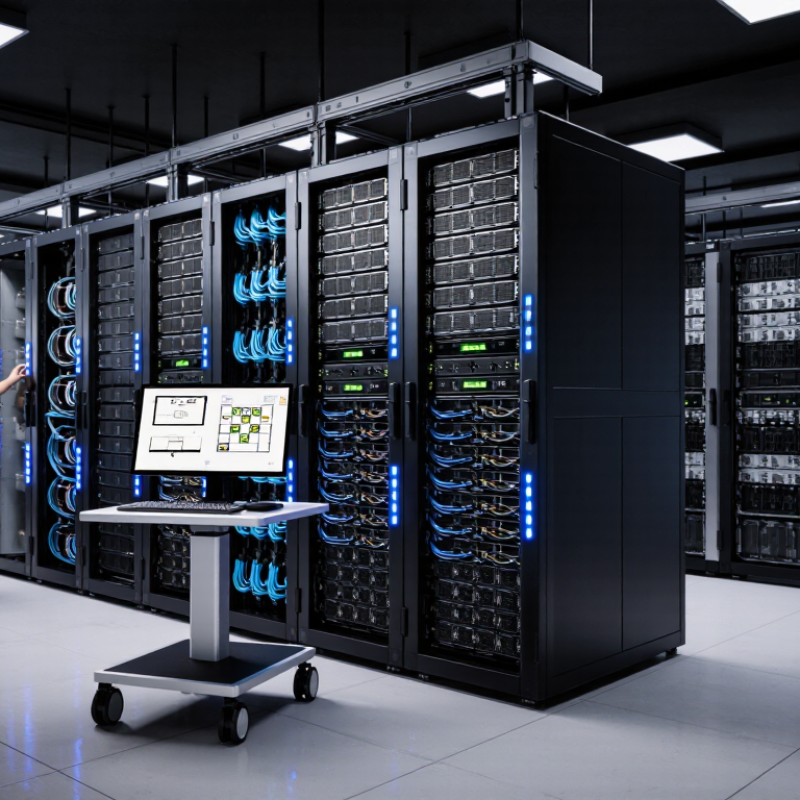
Before comparing AI server manufacturers, translate your workload into measurable requirements. Training large language models stresses accelerator throughput, memory capacity, and fast interconnects. Inference often rewards predictable latency and efficiency at steady utilization. Record model size, batch size, context length, target response time, and expected daily usage. Peak benchmark scores can mislead. Test with representative data.
Power and cooling belong in the same calculation as compute. The International Energy Agency’s Electricity 2024 report estimates that data centres used about 460 TWh globally in 2022, with consumption potentially exceeding 1,000 TWh by 2026. Gartner also forecast that 40% of existing AI data centres could face power constraints by 2027, up from 20% in 2023. Ask manufacturers for measured power draw and thermal output under your expected workload, plus rack-level requirements. Check whether your site can support the proposed density and cooling method before sizing a cluster. Details matter. A pilot run can expose bottlenecks in memory bandwidth, network traffic, or sustained power that a short demo misses. Forecasts are imperfect, too; leave capacity for growth without buying for an imagined workload.
| Workload | Typical Workload Scale | Accelerator Memory Planning | Compute and Interconnect Priorities | Storage and Data Pipeline | Host System and Power Considerations | Key Performance Measure |
|---|---|---|---|---|---|---|
| Model inference | Serving models from a few billion to tens of billions of parameters; workload may be latency-sensitive or high-throughput. | Size memory for model weights, runtime overhead, and the key-value cache. A 7B-parameter model in BF16 requires about 14 GB for weights alone; a 70B model requires about 140 GB before overhead. Quantization can reduce weight memory. | Prioritize sufficient accelerator memory, efficient batching, and low-latency links between accelerators when a model is split across devices. | Use fast local storage for model loading and a reliable path to shared model and application data. | Check accelerator power draw, cooling capacity, and the number of accelerators supported by the chassis and facility. | Tokens per second, time to first token, and concurrent requests at the required response latency. |
| Large-model training or fine-tuning | Multi-accelerator training, from parameter-efficient fine-tuning to full training of large models. | Account for weights, gradients, optimizer states, activations, and parallelism strategy. These can require substantially more memory than model weights alone; use high-memory accelerators or distribute the workload. | Prioritize high accelerator-to-accelerator bandwidth and low communication latency. Multi-node jobs generally benefit from a high-speed, low-oversubscription fabric. | Provide high-throughput reads for datasets and checkpoints. Parallel storage may be needed when many workers load data simultaneously. | Verify sustained rack power, cooling, and system stability during long-running jobs; peak power and heat are significant at multi-accelerator scale. | Training steps per second, time to train, accelerator utilization, and checkpoint/restart time. |
| Computer vision and image generation | Image classification, detection, segmentation, image synthesis, or video analysis with batches of images or frames. | Choose memory based on image resolution, batch size, model architecture, and whether training or inference is required. Higher resolution and larger batches increase memory use. | Prioritize strong accelerator throughput and enough host-to-accelerator bandwidth to keep input pipelines supplied. | Use storage sized for datasets, annotations, generated outputs, and intermediate files; measure data-loading throughput with the intended file format. | Plan for sustained accelerator utilization and adequate airflow or liquid-cooling support where required by system design. | Images or frames per second, training time per epoch, and performance at the target resolution. |
| Recommendation and tabular machine learning | Embedding-heavy recommendation models, feature processing, and structured-data training or inference. | Large embedding tables can make system memory and memory bandwidth important; accelerator memory needs depend on how embeddings and features are partitioned. | Evaluate memory bandwidth, CPU capability, and data movement between host memory and accelerators. Distributed deployments may need fast node-to-node networking. | Plan for feature-store access, frequent reads, and checkpoint capacity. Storage latency and data preprocessing can be bottlenecks. | Balance CPU cores, system memory capacity, and accelerators to avoid leaving compute idle while features are prepared. | Records or queries per second, end-to-end latency, and cost per prediction at the target quality level. |
| Scientific computing and simulation | Mixed AI and numerical workloads, such as surrogate models, simulation acceleration, or large-scale data analysis. | Match memory capacity to the largest dataset, simulation state, and model that must fit in memory; include headroom for intermediate tensors. | Assess accelerator compute capability, memory bandwidth, and communication performance for the application’s parallel pattern. | Consider sustained bandwidth for large datasets, simulation outputs, and restart files; confirm the software can use the proposed storage path. | Check power and cooling for sustained runs, plus CPU, memory, and expansion capacity required by the simulation software. | Time to solution, scaling efficiency across devices, and application-specific accuracy or convergence. |
| AI development and experimentation | Small-to-medium training runs, prototyping, evaluation, and shared team use. | Choose memory to fit the largest intended model, batch, and sequence length, with room for experimentation and concurrent processes. | Favor a flexible configuration with adequate accelerator links and networking for planned growth; single-node workloads may not need a multi-node fabric. | Provide enough fast local capacity for environments, datasets, and checkpoints, with backup or shared storage for team assets. | Consider noise, space, circuit capacity, and cooling constraints in addition to peak performance. | Experiment turnaround time, number of concurrent users, and utilization across the team’s typical workloads. |
Planning note: These are workload-based selection considerations, not fixed minimum specifications. Actual requirements vary with model architecture, precision, sequence length, batch size, software, and service-level targets. Validate candidate systems with representative benchmarks and measure performance at the intended scale.
Record model size, batch size, context length, target response time, and expected daily usage. Test with representative data, not only peak benchmarks. A short demo can hide bottlenecks.
Training often needs high accelerator throughput, memory capacity, and fast links between accelerators. Inference may need steady performance, predictable response times, and efficient power use. The right balance depends on your workload.
Ask for measured power draw and heat output during your expected workload. Compare those figures with your site’s rack, power, and cooling capacity. Details matter. Leave some room for growth, but avoid sizing around an imagined workload.
Match accelerator memory and compute capacity to your model, batch volume, and precision needs. More accelerators do not automatically solve memory or cooling limits. Run a pilot with your own workload where possible.
Check bandwidth, adapter capacity, expansion slots, and how traffic moves between servers. Confirm that the proposed setup supports your planned cluster size. Specification sheets may not reveal congestion.
Check steady data-loading and checkpoint throughput, usable capacity, and options for expansion or replacement. Compare power use under similar workloads. Heat matters. Request longer tests, since a brief benchmark may miss throttling.
Confirm the certificate’s issuer, scope, expiration date, and audited facility. Match test reports to the exact model and configuration in your quotation. Ask customers with similar systems about failures and repair times. Paperwork alone proves little.
Check support periods for firmware, management tools, operating systems, and accelerator generations. Verify rack rails, power connectors, network links, and cooling capacity before purchase. Ask for a written upgrade path. I would look twice if the answer stays vague.
Choosing among top ai server manufacturers starts with a clear understanding of your workloads, performance targets, and expected growth. Consider whether the systems can support your computing needs today while allowing room to scale. Compare their architectures and assess GPU configurations, networking capabilities, storage options, and energy efficiency to determine how well each solution fits your environment.
Look beyond specifications when evaluating a manufacturer. Review reliability, security features, technical support, and the total cost of ownership, including operation and maintenance. Verify relevant certifications and seek credible customer evidence to understand how systems perform in practice. Finally, consider long-term compatibility with your software, infrastructure, and future requirements. A careful comparison across these factors can help you choose an AI server solution that is practical, dependable, and suited to sustained use.
